Raising Multilingual Children: Everything Parents Need to Know
Raising multilingual children can be an extraordinary opportunity, but it does not always feel simple. Whether your child is growing up with two, three, or more languages, the journey involves more than choosing a method. It depends on your family relationships, daily routines, emotional connection, school environment, and the real opportunities your child has to hear and use each language.
Raising multilingual children means supporting a child’s development in two or more languages through meaningful exposure, real opportunities to communicate, emotional connection, and a realistic family language strategy. There is no single best method. What matters most is that the languages remain useful, valued, and sustainable in the child’s everyday life.
Parents often begin this journey with enthusiasm and clear intentions. Over time, however, questions arise. Are we using the right strategy? Is our child receiving enough exposure? Why does our child understand one language but answer in another? Should we continue with OPOL? Are we expecting too much?
There is no single method that works for every bilingual or multilingual family.
Your child’s language development is influenced by your family relationships, routines, community, school environment, emotional experiences, and the real opportunities they have to use each language.
The goal is not to create perfect balance between languages. The goal is to build a multilingual family life that is meaningful, sustainable, and supportive of your child’s wellbeing.
In this article, we will explore:
What Does Raising Multilingual Children Really Mean?
Is It Possible to Raise a Child with More Than Two Languages?
Start with Your Family’s Reality
The Five Foundations of Raising Multilingual Children
Choosing a Family Language Strategy
Common Concerns When Raising Multilingual Children
What Helps a Heritage Language Survive?
School, Community Language, and Language Dominance
Focus on Progress, Not Perfection
When Professional Support Can Help
Create Your Family Language Plan
Get Support for Your Multilingual Family
What Does Raising a Bilingual or Multilingual Child Really Mean?
Raising a multilingual child does not mean trying to create a perfectly balanced speaker of two, three, or more languages.
A multilingual child is not simply two monolingual children in one person. Children growing up with more than one language may use different languages with different people, in different places, and for different purposes. They may know the vocabulary of home routines in one language and the vocabulary of school, friendships, or play in another.
Their skills may also change over time.
One language may become stronger after starting daycare or school. A heritage language may become less active when the majority language begins to dominate daily life. A child may understand a language very well without feeling confident or motivated enough to speak it.
This does not automatically mean that the family’s multilingual journey is failing. It means that multilingual development is dynamic.
Instead of asking whether your child is “perfectly bilingual” or “balanced” in all languages, it is more useful to ask:
Is my child able to communicate meaningfully across their languages, relationships, and daily life?
Is It Possible to Raise a Child with More Than Two Languages?
Yes. Children can grow up with two, three, or more languages, and many do so around the world.
The real question is not: “How many languages are too many?”
A better question is: “What role does each language have in the child’s real life?”
A child may hear one language from one parent, another from the other parent, a third language at school, and perhaps a fourth language from grandparents, caregivers, or the wider community. This does not automatically create confusion.
What matters is whether each language has meaningful exposure, real people attached to it, and real opportunities for communication.
A language that is only present passively, for example through occasional screen time, will usually develop differently from a language connected to daily interaction, emotional relationships, stories, play, school, or family routines.
So instead of trying to give every language exactly the same amount of time, ask:
Which languages does my child hear regularly?
Which languages does my child need to use?
Which languages are connected to important relationships?
Which languages need more support because they are not present in school or the wider community?
Which routines can we realistically maintain?
Raising multilingual children is not about adding as many languages as possible. It is about creating a sustainable language environment where each important language has a place, a purpose, and a connection to your child’s everyday life.
Start with Your Family’s Reality
Before choosing a language strategy, look carefully at your actual family situation.
A strategy that works well for one family may feel unnatural or impossible for another. One family may succeed with One Parent One Language because each parent feels comfortable consistently using a different language. Another family may need Minority Language at Home, Time and Place, or a more flexible Family Language Plan.
The best approach is not the strictest one. It is the one your family can maintain with confidence, consistency, and emotional connection.
Ask yourself:
Which languages are part of our family?
Who speaks each language with the child?
Which languages does the child hear at daycare, school, and in the community?
How much meaningful contact does the child have with each language?
Which languages does the child genuinely need to use?
Which languages are connected to important relationships?
What are our long-term hopes?
What can we realistically sustain?
These questions matter because multilingual development does not happen in the abstract. It happens in real homes, real routines, real relationships, and real communities.
The Five Foundations for Raising Multilingual Children
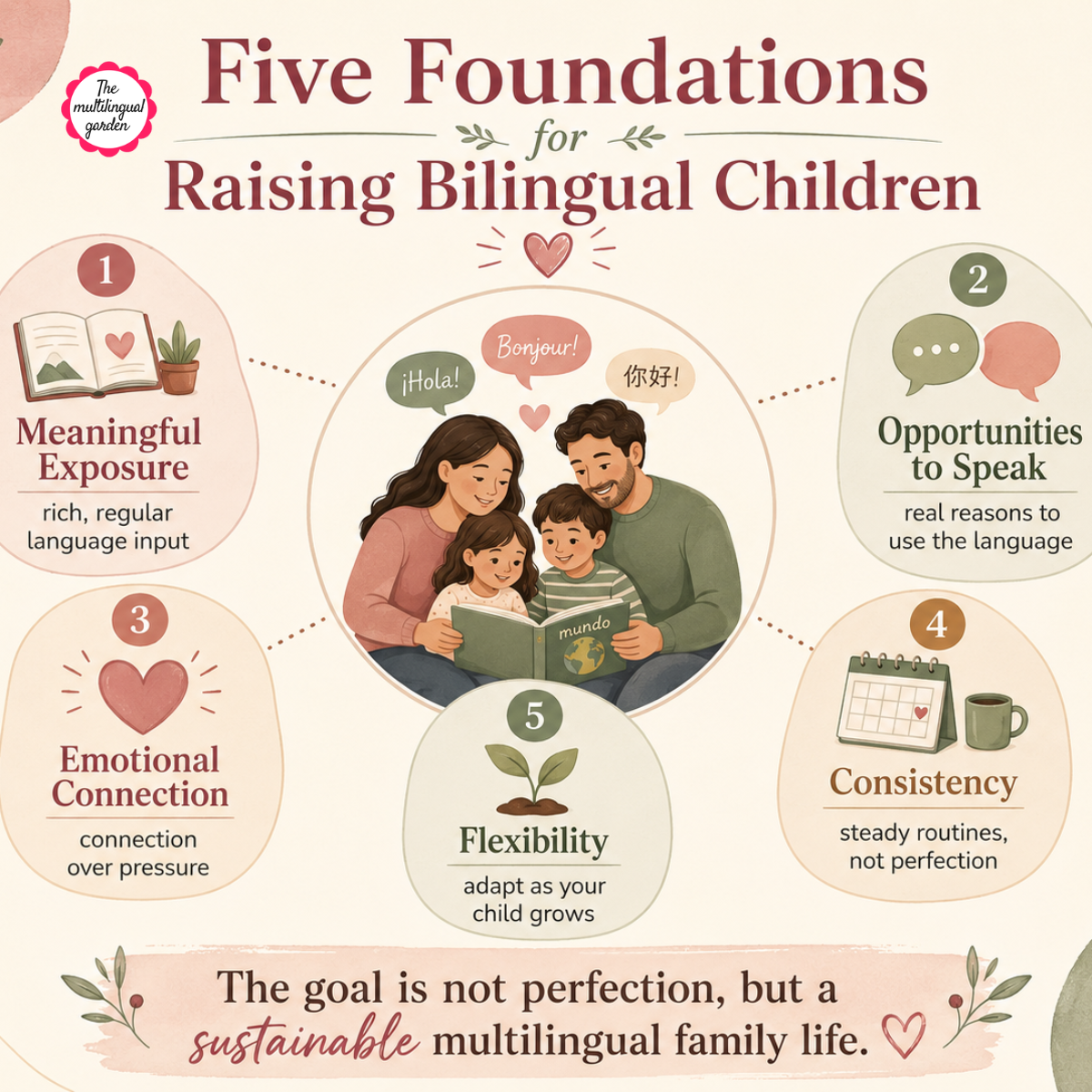
Raising multilingual children is not only about choosing a method such as OPOL or Minority Language at Home. A strategy can help, but it is the daily environment that makes multilingual development possible.
These five foundations matter in almost every multilingual family.
1. Create meaningful language exposure
Children need regular contact with a language, but exposure is not only about counting hours. The quality of the interaction matters.
Conversations, shared play, stories, songs, family routines, visits, and relationships offer richer language experiences than passive exposure alone.
Whenever possible, connect each language to real people, emotions, activities, and experiences.
2. Give your child a reason to use the language
Understanding a language does not always lead automatically to speaking it.
A child may answer in the majority language because everyone understands it, because it feels easier, or because they rarely need to use the other language.
Create natural opportunities for active communication without turning every interaction into a test.
This may include:
spending time with relatives who use the language;
joining playgroups or community activities;
reading and discussing stories together;
arranging calls with family members;
visiting places where the language is used;
involving the child in enjoyable routines connected to the language.
Avoid constantly asking the child to repeat, translate, or “say it properly.” Pressure can make communication feel less spontaneous.
3. Protect the emotional connection
Languages are not only systems of vocabulary and grammar. They are connected to relationships, belonging, identity, and emotion.
A child may associate one language with affection, grandparents, bedtime stories, holidays, or family traditions. They may also associate it with correction, pressure, conflict, or the feeling that they are not good enough.
Try to make the language a space for connection rather than performance.
Speak, play, laugh, read, cook, and share experiences through the language. The relationship should remain more important than grammatical accuracy.
4. Be consistent without becoming rigid
Consistency helps children understand where, when, and with whom a language is used. However, consistency does not mean perfection.
Real multilingual families mix languages, change routines, adapt to school schedules, and respond to changing circumstances. A parent may occasionally use another language because of tiredness, social situations, or practical needs.
This does not destroy bilingual development. Instead of asking, “Are we following the method perfectly?”, ask:
Is this language still present, meaningful, and regularly used in our family?
5. Review your plan as your child grows
A language strategy that works with a toddler may no longer work when the child starts school.
Children’s social worlds expand. Friends, teachers, media, and community languages become increasingly influential. Family circumstances may also change through relocation, new siblings, work schedules, or school transitions.
Review your language plan periodically. Consider what is working, what has become difficult, and what small changes could make the strategy more realistic.
Choosing a Family Language Strategy
Once you understand your family’s reality, you can choose a language strategy that supports your goals.
A family language strategy is not a rigid rulebook. It is a practical way to decide who uses which language, when, where, and why. The right strategy should make your multilingual family life clearer, not more stressful.
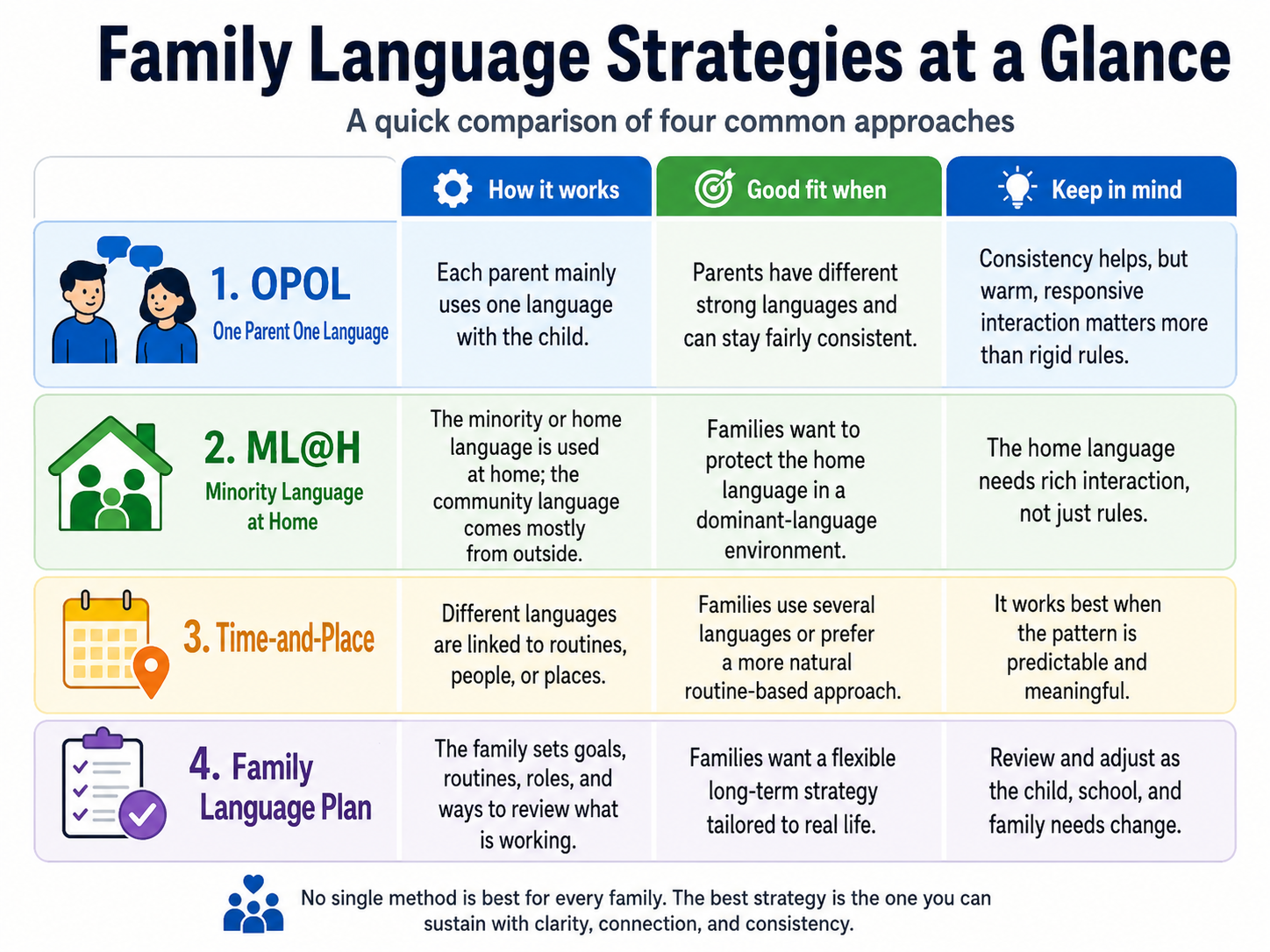
Here are four common approaches.
One Parent One Language: OPOL
In the One Parent One Language approach, each parent mainly uses one language with the child. For example, one parent may speak Spanish while the other speaks English.
This can work well when both parents feel comfortable and consistent in their chosen language, and when the child receives enough meaningful exposure to both languages.
However, OPOL is not a guarantee. If one parent speaks the minority language but has very little time with the child, that language may still need additional support through books, relatives, playgroups, travel, or community activities.
Minority Language at Home: ML@H
In the Minority Language at Home approach, the family uses the minority or heritage language at home, while the majority or community language is mainly learned outside the home.
This can be especially useful when the community language is very dominant through daycare, school, friends, media, and daily life.
ML@H often gives the home language stronger protection, because it does not depend on only one parent carrying the language alone.
Time and Place
In the Time and Place strategy, different languages are connected to specific routines, moments, or places.
For example, a family might use one language during dinner, another language at bedtime, or the heritage language during weekends, holidays, or video calls with relatives.
This strategy can be more flexible than OPOL, but it works best when the pattern is predictable and meaningful for the child.
Family Language Plan
A Family Language Plan is a more flexible approach. Instead of following one method perfectly, the family reflects on its languages, goals, routines, and challenges, then creates a plan that fits real life.
A family language plan may combine elements of OPOL, Minority Language at Home, and Time and Place. It can also change over time as the child grows, starts school, gains new interests, or develops different language preferences.
For many multilingual families, this is the most realistic option: not a perfect method, but a clear and adaptable plan.
Common Concerns When Raising Multilingual Children
“Will two languages confuse my child?”
Using or mixing languages is a normal feature of multilingual communication.
Children may use a word from one language while speaking another because that word is more accessible, because it belongs to a particular context, or because they know the person listening understands both languages.
Language mixing is not, by itself, evidence of confusion.
And spoiler: adults do it too!
“Will my child speak later?”
Children develop at different rates, whether they are growing up with one language or several.
Multilingualism itself should not automatically be treated as the explanation for a child’s speech or language difficulties. Concerns should be considered across all the languages the child uses, rather than evaluating only one language in isolation.
When parents are worried, it is important to seek guidance from a professional who understands multilingual development.
“Why is one language becoming weaker?”
This often happens when a child begins spending more time in a majority-language environment.
School, friendships, activities, and media can quickly strengthen one language while reducing the child’s practical need to use the family language.
Maintaining a heritage language usually requires intentional support, especially as children grow older.
“Do we need to use OPOL?”
No.
One Parent One Language is one possible strategy, not a universal rule.
It may work well when both parents feel comfortable with the arrangement and the child receives meaningful exposure to both languages. Other families need a more flexible approach.
The right strategy depends on your languages, relationships, routines, goals, and community context.
For some families, a flexible family language plan is more useful than trying to follow one method perfectly.
“Are we doing enough?”
This is one of the most common worries in multilingual families.
Parents often wonder whether they are providing enough exposure, whether they should be more consistent, whether they should add more books, more activities, more trips, more calls, or more structure.
Sometimes the answer is yes: a language may need more intentional support. But sometimes the family is already doing a lot, and the real issue is not effort. It is clarity.
Instead of asking only, “Are we doing enough?”, ask:
Is this language present regularly?
Is it connected to meaningful relationships?
Does my child have a reason to use it?
Is our routine sustainable?
Is the language associated with connection rather than pressure?
You do not need to do everything. You need to know what matters most for your family.
What Helps a Heritage Language Stay Alive?
A heritage or minority language needs more than occasional exposure.
It needs a place in the child’s wider life.
For many multilingual families, this is one of the biggest long-term challenges. A child may understand the family language well in the early years, but once daycare, school, friendships, activities, and media become dominated by the community language, the heritage language may become less active.
Helpful forms of support may include:
regular conversations with extended family;
books and stories;
music, films, and age-appropriate media;
friendships with other speakers;
community or heritage-language groups;
visits to places where the language is widely used;
meaningful family traditions;
opportunities to develop literacy when appropriate.
Most importantly, the child needs to feel that the language is valued and useful. A heritage language survives more easily when it is connected to real relationships, enjoyable routines, and meaningful participation in family life.
Avoid describing the majority language as more useful, more important, or more prestigious. Children quickly notice how adults speak about different languages.
School, Community Language, and Language Dominance
When children start daycare or school, the balance between their languages often changes.
This is especially common when the school language is also the majority language of the community. Suddenly, one language becomes connected to teachers, friends, activities, books, songs, homework, and social life.
This does not mean that the child has “chosen” one language over the others. It usually means that one language has become more present, more necessary, and more socially useful in daily life.
For many multilingual children, language dominance is not fixed. A child may feel stronger in one language at school, another language with grandparents, and another language during holidays or travel. Their confidence may also change depending on the topic, the person, or the situation.
This is why it is not helpful to expect perfectly balanced multilingualism.
Instead, observe how your child’s languages are developing over time:
Which language does your child use most easily?
Which language does your child understand but rarely speak?
Which language is connected to school or friends?
Which language is connected to family and emotional life?
Which language needs more active support right now?
If one language is becoming weaker, the solution is not usually to panic or pressure the child. The first step is to understand what has changed in the child’s environment, and then adjust the family language plan accordingly.
Focus on Progress, Not Perfection
Many parents begin raising multilingual children with the hope that their child will speak every language equally well.
In reality, perfectly balanced multilingualism is uncommon.
A child may be stronger in one language, prefer different languages in different contexts, or move through periods when one language develops more quickly than another.
These differences do not reduce the value of multilingualism.
Rather than comparing your child with monolingual children, siblings, cousins, or other multilingual families, observe their individual development over time.
Ask:
Is the child communicating?
Are their skills developing across their languages?
Do they understand more than they can currently express?
Do they have meaningful opportunities to use each language?
Does the family language routine support connection and wellbeing?
Progress in multilingual development is not always linear. What matters is not whether every language develops in exactly the same way, but whether your child’s languages continue to have space, meaning, and support in daily life.
When Professional Support Can Help Your Multilingual Family
You do not need to wait until your family is in crisis to ask for support.
Sometimes parents seek help because they are worried about speech or language development. In that case, it is important to consult a qualified speech and language therapist, ideally someone with experience in bilingual or multilingual development.
But not every multilingual family concern is clinical.
Sometimes the question is not whether the child has a speech or language difficulty, but whether the family needs a clearer, more realistic language plan.
Professional guidance may be useful when:
your child consistently refuses one language;
your family strategy creates stress or conflict;
you are receiving contradictory advice;
you are unsure whether your child’s language situation reflects typical multilingual development or whether it should be discussed with a speech and language therapist;
a school transition is approaching;
the heritage language is rapidly becoming less active;
parents disagree about language choices;
you want to introduce another language;
you need a realistic family language plan.
A multilingual family consultation can help you understand your family’s language situation, clarify your priorities, identify what is realistic, and decide on practical next steps.
If there are signs of a possible speech, language, hearing, psychological, or learning difficulty, a consultation with a multilingual family consultant does not replace clinical assessment. In that case, the right step is to contact a qualified clinical professional.
If there are no clinical red flags, but you feel confused about exposure, routines, school language, heritage language maintenance, or family language choices, strategic support can help you build a plan that fits your real life.
Create Your Family Language Plan
Raising multilingual children becomes easier when you move from vague worries to a clearer plan.
A Family Language Plan does not need to be complicated. It is simply a way to decide what matters most for your family, how each language fits into daily life, and what small routines can support your child over time.
Start with these steps:
List all the languages in your child’s life.
Identify where, when, and with whom each language is used.
Notice which languages are strong, active, passive, or becoming weaker.
Decide which languages need more intentional support.
Choose a realistic strategy, such as OPOL, Minority Language at Home, Time and Place, or a flexible combination.
Create small routines that your family can actually maintain.
Review the plan every few months, especially after school transitions, relocation, or changes in family life.
The goal is not to control every language interaction. The goal is to create enough clarity so that your family can make intentional decisions without turning multilingual parenting into pressure, guilt, or constant self-doubt.
Get Support for Your Multilingual Family
Every multilingual family has a different combination of languages, relationships, routines, challenges, and goals.
That is why raising multilingual children is not about copying someone else’s method. It is about understanding your own family situation and creating a plan that your child and your family can actually live with.
If you are at the beginning of your multilingual parenting journey, you can start with my Free Multilingual Parenting Guide. It will help you understand the foundations of raising children with more than one language and reflect on your own family situation.
If you need more personalized support, a multilingual family consultation can help you clarify your goals, understand what is realistic, and build a Family Language Plan that fits your real life.
Frequently Asked Questions About Raising Multilingual Children
-
Yes. Many children grow up with two, three, or more languages. What matters is not the number of languages alone, but the quality of exposure, the child’s opportunities to use each language, and the emotional relationships connected to those languages.
-
There is no single best method for every family. Some families use One Parent One Language, others use Minority Language at Home, Time and Place, or a flexible Family Language Plan. The best method is the one your family can sustain with clarity, connection, and consistency.
-
No. Growing up with more than one language does not confuse children. Multilingual children may mix languages, prefer one language in certain contexts, or understand more than they speak, but these patterns are common in multilingual development.
-
Multilingualism itself does not cause speech or language delay. However, multilingual children can still have speech or language difficulties, just like monolingual children. If you are concerned about your child’s development across their languages, it is important to consult a qualified speech and language therapist.
-
This is very common. A child may understand a language but answer in another because the other language feels easier, more socially dominant, or more useful in daily life. This pattern is often called receptive bilingualism.
-
A heritage language needs meaningful exposure and real reasons to be used. Relationships, stories, play, calls with relatives, visits, songs, community activities, and family routines can all help the language remain active and emotionally meaningful.
-
Not every family needs a written plan, but many families benefit from one. A Family Language Plan helps you clarify your goals, decide how each language fits into daily life, and adjust your strategy as your child grows.
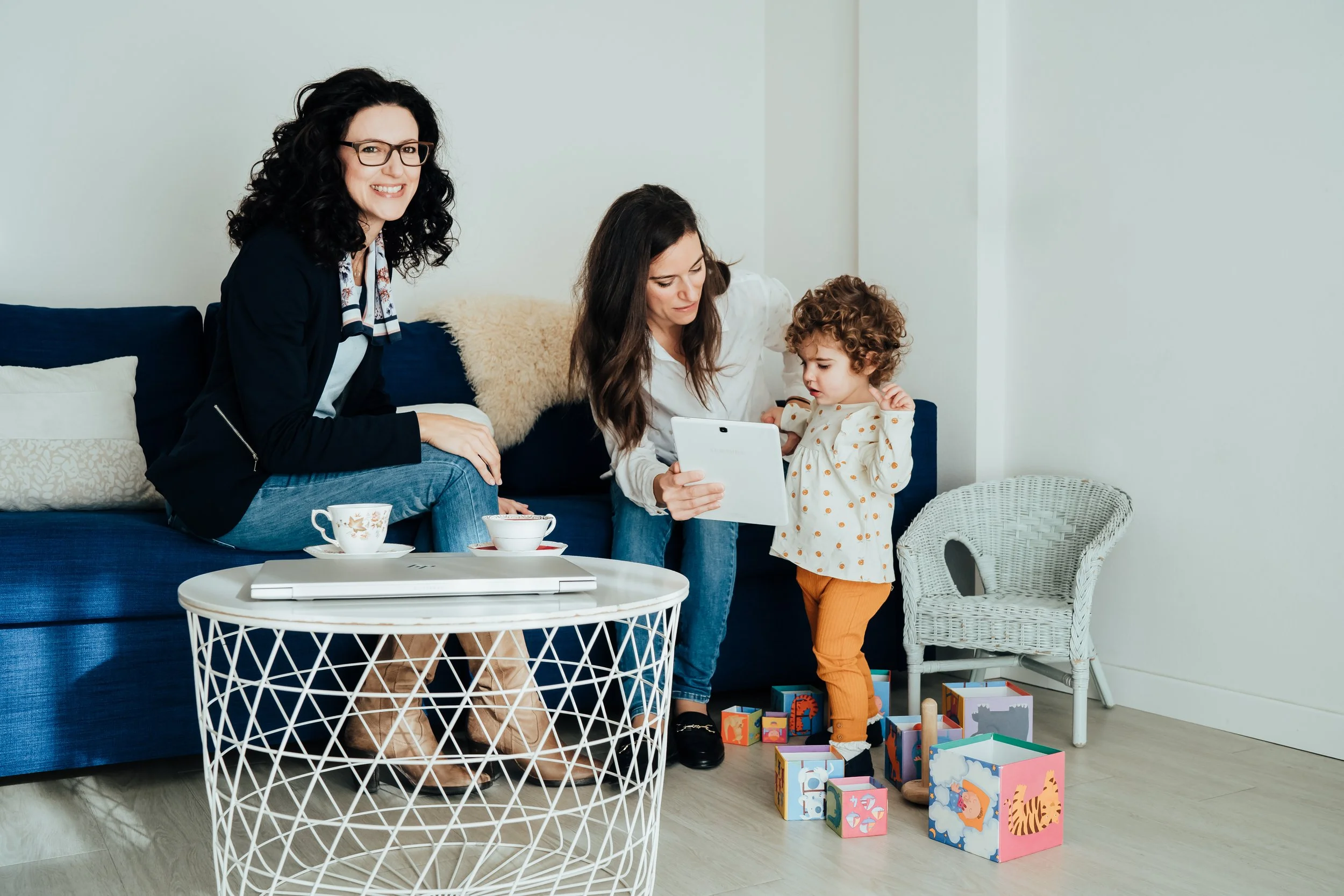
Dr. Karin Martin is a linguist, multilingual family consultant, author, trainer, and founder of The Multilingual Garden. She holds a PhD in Linguistics and has worked with multilingual families, educators, and international schools since 2014.
Her work helps families understand their child’s multilingual situation, make informed decisions about language use at home, and create realistic family language strategies that support long-term bilingual and multilingual development.
She is the author of Watch Your Language, Mom! A Guide to Multilingualism and supports families through private consultations, parent seminars, training programs, and practical resources on multilingual child development.