One Parent One Language (OPOL): When It Works, When It Doesn't, and What to Do Instead

If you've spent any time researching how to raise a bilingual child, you've almost certainly come across the term OPOL: One Parent One Language. It's the most widely recommended bilingual parenting strategy, and for good reason: when it works, it works beautifully. But in my work with multilingual families, I see just as many parents who feel like OPOL is failing them, and they assume that means they're failing.
They aren't. OPOL is a strategy, not a guarantee, and it doesn't fit every family the same way. In this guide, I'll walk you through what the one parent one language method actually is, when it works best, why it sometimes breaks down, and what to do if it's not working for your family, including several proven alternatives.
What Is the One Parent One Language Method?
The one parent one language approach is a family language strategy in which each parent consistently speaks one language to the child. Typically, this means each parent uses their native or dominant language, so the child receives consistent, separate input in two languages from two consistent sources.
For example, in a family where one parent is a native Spanish speaker and the other a native English speaker, the OPOL method means Mom always speaks Spanish to the child and Dad always speaks English to the child, regardless of what language the parents speak to each other, or what the child answers back in.
The idea behind OPOL isn't new. It's rooted in the concept that children can distinguish between languages more easily when each language is tied to a consistent person, rather than mixed within the same conversation. The one-parent-one-language approach itself dates back much further than its modern popularity: the underlying idea was first described by French linguist Maurice Grammont in 1902, and later documented by Werner Leopold's landmark 1930s study raising his daughter bilingually. The term OPOL as a structured, intentional strategy for parents was popularized more recently by researcher and author Suzanne Barron-Hauwaert.
It's worth noting: OPOL is a strategy for language input, not a rule about what the child must speak back. A child can understand and respond in Spanish to their Spanish-speaking parent without ever producing much spoken Spanish themselves, that's a different (and very common) challenge called receptive bilingualism, which I cover in a separate guide.
The Benefits of OPOL in Multilingual Families
When OPOL works, families tend to report a few consistent advantages:
Clarity for the child. A consistent person-language link gives young children an intuitive, low-effort way to organize two language systems, particularly in the early years when they're first sorting out that they're learning two languages, not one.
Predictable, high-quality input. Because each parent sticks to their strongest language, children generally receive richer, more natural, and more grammatically consistent input than they would if a parent tried to speak a weaker second language.
Stronger identity connection. For parents raising children abroad or in a mixed-culture household, speaking your own native language consistently often supports a deeper emotional and cultural connection between parent and child.
A structure both parents can commit to. Compared to strategies that require ongoing negotiation (like deciding language by topic or location), OPOL offers a simple rule that's easy to explain to extended family, caregivers, and schools.
None of this means OPOL is the only path to bilingualism, or even the best one for every family. It's one well-documented option among several, and its success depends heavily on conditions outside the strategy itself.
When OPOL Works Best (And the Conditions It Needs)
OPOL tends to succeed when a family can maintain a few key conditions over time:
Consistency, not perfection. Children adapt well to a parent who reliably speaks one language to them, even if that parent occasionally slips into the other language. What undermines OPOL isn't the occasional lapse, it's chronic inconsistency, where a parent switches languages so often that the child never forms a clear expectation.
Sufficient exposure to the minority language. If one language is a majority language (spoken at school, in the community, on TV, with friends) and the other is a minority language (spoken mainly by one parent), that minority language needs enough total exposure time to develop, not just consistency from one speaker. A parent who is away at work most of the day may be providing consistent input, but not necessarily enough of it.
Support from the environment, not just the strategy. OPOL works best when it's reinforced - by books, media, extended family, playdates, or community groups in the minority language - rather than left to carry the entire weight of language development on its own.
Both parents genuinely on board. OPOL asks a lot of the parent speaking the minority language, and it also asks the other parent to actively support that effort rather than undermine it (for example, by always translating for the child or discouraging the minority language "for simplicity"). When both parents are aligned, OPOL has room to succeed.
Realistic expectations. Families who see OPOL as a long-term framework rather than a fast track to fluent, balanced bilingualism tend to stick with it through the normal ups and downs of a child's language development.
When OPOL Doesn't Work: Common Challenges and Mistakes
I want to be direct about this, because it's the part parents rarely hear: OPOL is a strategy, and like any strategy, it can be applied in ways that don't fit a family's real circumstances. When that happens, it's not a parenting failure, it's usually a signal that the strategy needs to be adjusted.
The most common reasons OPOL struggles:
Not enough total exposure to the minority language, especially once a child starts school in the majority language and their social world shifts.
Inconsistent application, where the "rule" exists in theory but isn't followed day to day, so the child never internalizes a clear pattern.
One parent feeling isolated or unsupported in maintaining their language, particularly if extended family or the community defaults to the majority language.
A shift in family circumstances that changes the language balance. This is something I see often in cases of separation or divorce, where a child suddenly spends significantly less time with the parent who spoke the minority language, and that language's presence in daily life drops sharply as a result. If this applies to your family, I go into this in much more depth in my article on divorce and multilingualism.
The child pushing back, especially around ages 3 to 6, by consistently answering in the majority language even when addressed in the minority one, a normal developmental phase, but one that discourages parents if they don't expect it.
Family stress around the strategy itself, where OPOL becomes a source of guilt or conflict rather than a natural part of daily life.
Mixed-Language Households: Can OPOL Still Work?
Many real families don't fit the textbook OPOL example. Maybe both parents share a language they speak to each other, or a grandparent living in the home speaks a third language, or the family relocates and a fourth language enters the mix through school.
OPOL can still function in these households, but it usually needs to be adapted rather than applied rigidly. Some families choose a modified version, one parent one language for the two "target" languages, while the community language is left to develop naturally through school and social exposure.
What matters is that the child has clarity about who speaks what, not that the household matches a textbook model exactly.
What If One Parent Is Not a Native Speaker?
OPOL is often described using native-speaker parents, but plenty of families successfully use a version of it where one parent speaks a language they learned later in life, sometimes to a high level of fluency, sometimes not. This can still work, particularly if that parent is genuinely comfortable and consistent in the language and the child gets meaningful additional exposure elsewhere (a bilingual school, a nanny, extended family, community programs). What tends to be harder is sustaining a non-native parent's motivation and consistency over years without that outside reinforcement, so if this is your situation, it's worth building in extra support for the minority language from other sources, rather than relying on one parent alone.
Alternatives to OPOL: Other Family Language Strategies
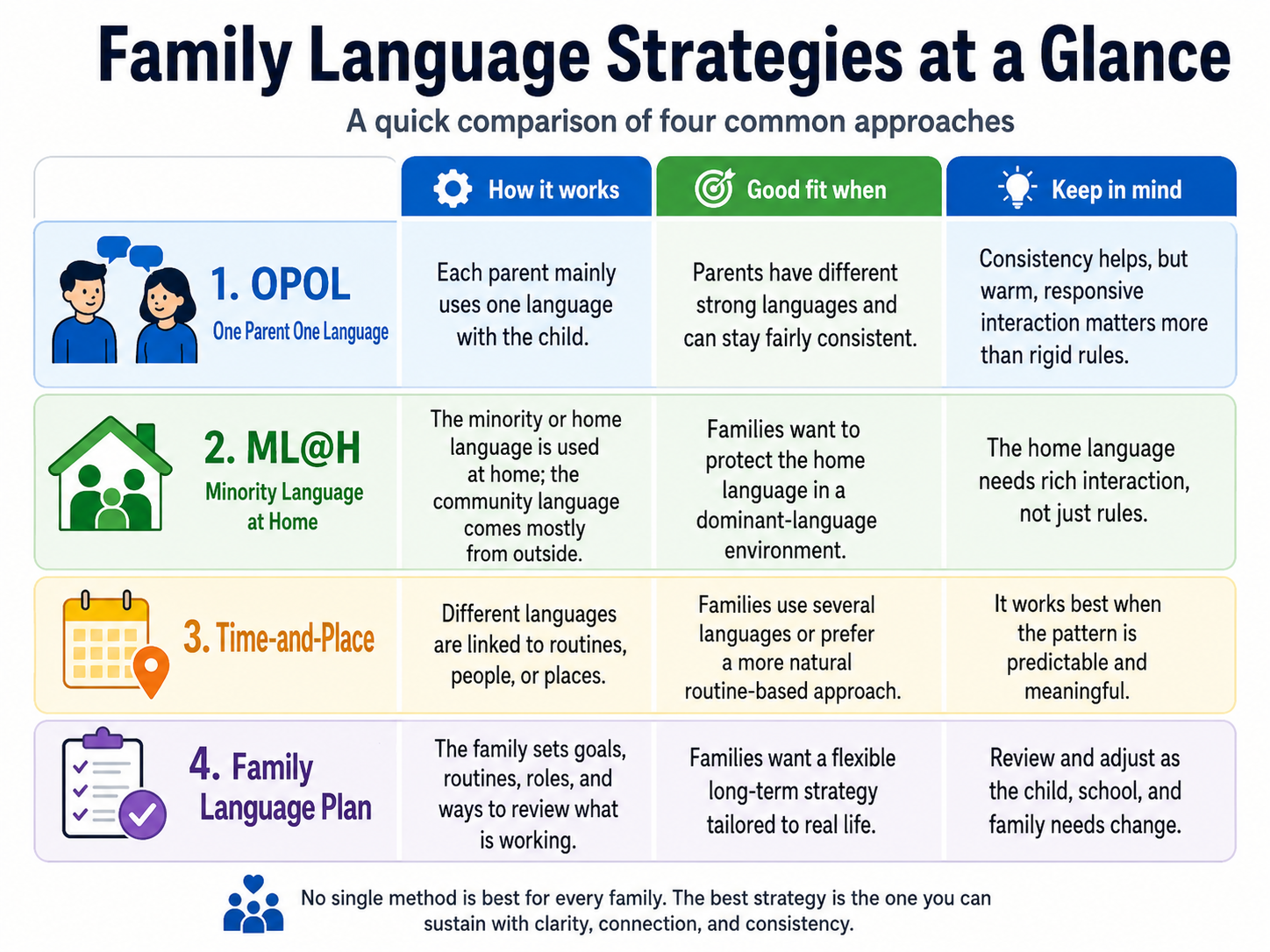
If OPOL isn't fitting your family, or you're planning your approach before your child is born, it helps to know that OPOL is one strategy among several well-established ones. None is inherently superior, the right choice depends on your family's languages, environment, and daily reality.
The Minority Language at Home (ML@H) Approach
In this strategy, both parents speak the minority language at home, regardless of who speaks what natively, while the child is expected to pick up the majority language through school and the wider community. ML@H is often chosen by families where the minority language has very little support outside the home - for instance, an immigrant family where both parents share a heritage language that isn't spoken locally at all. This approach tends to work well because it maximizes minority language exposure at exactly the point where children need it most, without relying on a single parent to carry it alone. If this fits your situation, I go deeper into building minority language exposure and identity in my guide to heritage language maintenance.
Time and Place Strategy
Rather than assigning a language to a person, this approach assigns it to a context - a certain day of the week, a certain time of day, or a certain place (for example, only the minority language during dinner, or only that language on weekends). It offers more flexibility than OPOL, which can help in households where a strict person-language link isn't practical, but it typically requires more conscious effort to maintain, since the "rule" is less automatic than simply speaking your own language.
The Family Language Plan Approach
This is less a fixed method and more a mindset: rather than adopting one named strategy wholesale, you map out your family's actual languages, environment, and goals, and build a plan around them - which might combine elements of OPOL, ML@H, and time-and-place depending on your circumstances and how they evolve. In my experience, this is often where families land eventually, even if they started with a stricter method. Your plan doesn't need to have a name; it needs to match your real life. If you'd like help mapping one out for your own family, I offer consultations to build a plan around your specific languages and circumstances.
OPOL and Speech Delay: Addressing the Biggest Fear
This is, understandably, the question I hear most from parents considering or currently using OPOL: will raising my child with two languages, using this strategy, cause a speech delay?
Here's what's important to understand: raising a child bilingually, including with OPOL, does not cause speech or language delay. Research on bilingual development support this. Bilingual children may distribute their vocabulary across two languages rather than concentrating it in one, and when only one language is measured, a bilingual child can appear to have a smaller vocabulary than a monolingual peer - but when both languages are counted together, bilingual and monolingual children generally reach expressive language milestones on a similar timeline.
That said, OPOL itself doesn't protect a child from a true speech or language delay, and it shouldn't be used as a reason to delay seeking help if you notice red flags. If your child isn't meeting general speech and language milestones - in either language, or overall - that's worth evaluating regardless of how many languages they're being raised with. I cover the specific age-by-age red flags and when to see a bilingual speech-language pathologist in detail in my guide to bilingual child speech delay.
A quick but important disclaimer: I'm a linguist and multilingual family consultant, not a speech-language pathologist, and nothing in this article is a substitute for a clinical evaluation. If you have concerns about your child's speech or language development, please consult a qualified, ideally bilingual, speech-language pathologist.
Frequently Asked Questions About OPOL
-
There isn't a single "best" method for every family - OPOL is simply the most researched and most commonly recommended strategy. Its effectiveness depends on your family's specific languages, environment, and consistency, not on the strategy being universally superior to alternatives like Minority Language at Home.
-
Consistency matters more than perfection. Occasional slips into the other language won't undermine OPOL, but frequent, unpredictable switching can make it harder for a young child to form a clear expectation of which language belongs to which parent.
-
This is extremely common, especially between ages 3 and 6, and it doesn't mean OPOL is failing. It often reflects which language feels more automatic or socially dominant for the child at that moment, not which language they understand. Continuing to speak your language consistently, without forcing a response, tends to work better than switching to match the child.
-
Yes, many OPOL families communicate with each other in a third shared language, or in one parent's non-native language, while still maintaining OPOL with the child. The child-directed consistency is what matters most for the strategy, not the language the parents use between themselves.
-
No. While starting early can make the language-person association easier to establish, families successfully introduce or shift toward OPOL later in a child's development, particularly when supported by consistent effort and additional exposure sources.
-
Reduced consistency doesn't erase previous progress, but it can slow the development of the less-supported language over time. If you notice OPOL slipping, it's usually more effective to adjust your approach intentionally (for example, adding structured exposure like books, media, or a language playgroup) than to feel it has to be all-or-nothing.
-
No. Being raised with two consistent language sources does not cause language confusion or delay. Mixing words between languages in early speech is a normal, temporary part of bilingual development, not a sign of confusion.
-
This varies widely by child, by how much total exposure each language receives, and by the specific languages involved. Rather than tracking short-term results, it's more useful to think of OPOL as a long-term input strategy that supports gradual bilingual development over years, not weeks or months.
Build Your Personalized Family Language Plan

OPOL works wonderfully for many families - and for others, a modified version, or a different strategy entirely, is a better fit. There's no single right answer, only the answer that's right for your family's languages, routines, and goals.
If you're unsure whether OPOL is working for you, want to adapt it to your specific situation, or are trying to choose a strategy before your child is even born, I help families build a language plan that actually fits their real life.
References
Barron-Hauwaert, S. (2004). Language strategies for bilingual families: The one-parent-one-language approach. Multilingual Matters.
Grammont's proposal / Ronjat's documentation:
Ronjat, J. (1913). Le développement du langage observé chez un enfant bilingue [The development of language observed in a bilingual child]. Champion.Leopold, W. F. (1939–1949). Speech development of a bilingual child: A linguist's record (Vols. 1–4). Northwestern University Press.