What Multilingual Parents Are Struggling With Right Now
(And What It Tells Us About Bilingual Parenting)
Last week, I asked a simple question on LinkedIn:
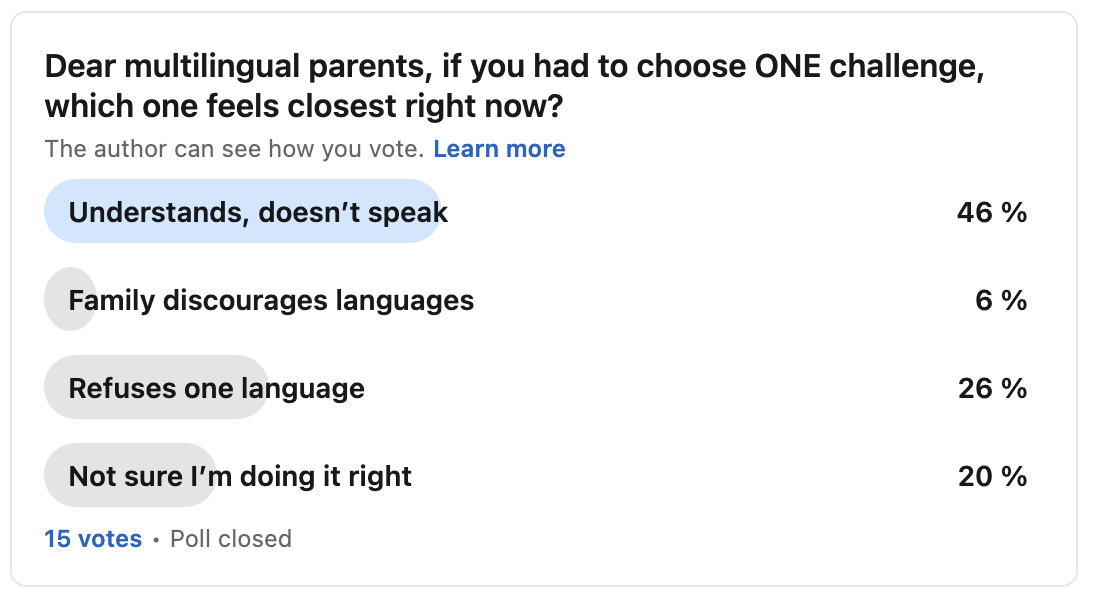
“Dear multilingual parents, if you had to choose ONE challenge, which one feels closest right now?”
Only 15 people responded.
Not a huge sample - but honestly, that’s not the point.
Because behind every vote, there is a real family. A real struggle. A real moment of doubt.
And in the world of bilingual parenting and multilingual parenting, these moments matter.
What Parents Told Me
Here are the results:
46% – Understands, doesn’t speak
26% – Refuses one language
20% – Not sure I’m doing it right
6% – Family discourages languages
Even with a small sample, a clear pattern emerges.
👉 The biggest challenge is not understanding.
👉 It’s speaking.
And that tells us something important.
The Most Common Fear in Bilingual Parenting
When parents say:
“My child understands everything, but doesn’t speak”
What they’re really saying is:
“Am I failing?”
“Will they ever speak?”
“Did I do something wrong?”
This is one of the most frequent concerns I hear in consultations. I wrote a full article about receptive bilingualism, the situation where a child understands a language but does not actively use it yet. You can read it here if this is the challenge your family is facing right now.
And here’s the truth:
👉 Understanding is not a problem. It’s progress.
A child who understands a language has already built a strong foundation. Speaking is the next step, but it doesn’t always come immediately.
In multilingual parenting, language development is not linear. It’s dynamic, emotional, and deeply contextual.
Why Children Understand But Don’t Speak
There are several reasons why this happens:
1. Passive knowledge comes first
Children often build comprehension before production. This is normal, even in monolingual development.
2. They don’t “need” the language
If a child knows they can switch to another language and still be understood, they will.
Language follows necessity.
3. Emotional comfort matters
Speaking requires exposure, but also confidence. If a child feels unsure, they may choose silence over risk.
4. Context matters more than ability
Many parents tell me:
“They don’t speak at home, but suddenly they speak on holiday!”
That’s not magic. That’s context.
Refusing One Language: A Deeper Signal
The second most common response in the poll was:
👉 “My child refuses one language” (26%)
This is often misunderstood.
Parents think:
“They don’t like the language”
“They’re losing it”
“We should push more”
But refusal is rarely about the language itself.
It’s often about:
Identity (“I want to fit in”)
Social pressure
Emotional associations
Power dynamics (“I choose what I speak”)
In bilingual parenting, refusal is communication.
The question is not:
👉 “How do I force them to speak?”
But:
👉 “What is this behavior telling me?”
😔 “Am I Doing It Right?” The Silent Weight of Multilingual Parenting
20% of parents chose:
👉 “I’m not sure I’m doing it right”
This one doesn’t always get discussed openly, but it’s everywhere.
Because multilingual parenting comes with invisible pressure:
Pressure from schools
Pressure from family
Pressure from society
Pressure from social media
And most importantly:
👉 Pressure from yourself.
You want to do it well.
You want to give your child opportunities.
You don’t want to make mistakes.
But here’s something I tell parents often:
👉 There is no perfect strategy. There is only a consistent, meaningful environment.
When Family Discourages Multilingualism
Even though only 6% chose this option, it triggered the strongest private messages.
Because this challenge is not just practical, it’s emotional.
Parents hear things like:
“Don’t confuse the child”
“Just speak the language of the country”
“It’s too much for them”
And suddenly, they feel alone in their choices.
In these situations, I often suggest:
💡 Explain your “why”
Why does this language matter to you?
💡 Educate gently
Most resistance comes from lack of knowledge, not bad intentions.
💡 Create allies
Involve family members in small ways, songs, books, simple phrases. I have a full chapter on this in my video course.
What These Results Really Tell Us About Bilingual Parenting
If we zoom out, this poll reveals something bigger:
👉 Multilingual parenting is not about language systems.
👉 It’s about relationships.
The relationship between parent and child
The relationship between languages
The relationship between identity and belonging
And most importantly:
👉 The relationship between expectations and reality
Because many parents expect:
Balanced languages
Equal proficiency
Smooth development
But real multilingual development looks like:
Uneven progress
Shifting dominance
Emotional ups and downs
Practical Tips You Can Apply Today
Based on both the poll and my experience working with families, here are some key strategies:
✔️ 1. Focus on connection, not correction
Children don’t speak because they are corrected.
They speak because they feel connected.
✔️ 2. Create meaningful routines
Language needs context:
Bedtime stories
Meals
Playtime
Weekly rituals
✔️ 3. Accept imbalance
One language may be stronger at times. That’s normal.
✔️ 4. Increase exposure strategically
Not just more input, but better input:
People
Experiences
Emotions
✔️ 5. Reduce pressure
Pressure blocks language.
Safety invites it.
A Final Thought
If you look at your child and think:
“Something is not working”
Pause for a moment.
Look again.
Are they:
Understanding?
Responding in another language?
Navigating between worlds?
Then something is working.
Maybe not in the way you expected, but in the way multilingual development often unfolds.
🤝 You’re Not Alone in This
Even if this poll had only 15 responses, it reflects something I see every single week:
👉 Parents trying their best
👉 Children navigating complex linguistic worlds
👉 Families searching for clarity
And if you see yourself in these words, know this:
You are not behind.
You are not doing it wrong.
You are in the process. Keep going! 🌱
Need a clearer starting point?
If you are raising a child with more than one language and want to feel more confident, download my free multilingual parenting guide.
It will help you understand the basics of multilingual development, reflect on your family language situation, and support your child with more clarity and less pressure.